

Choong Whan Park USC: The Research Legacy Behind the Paul D. Converse Award
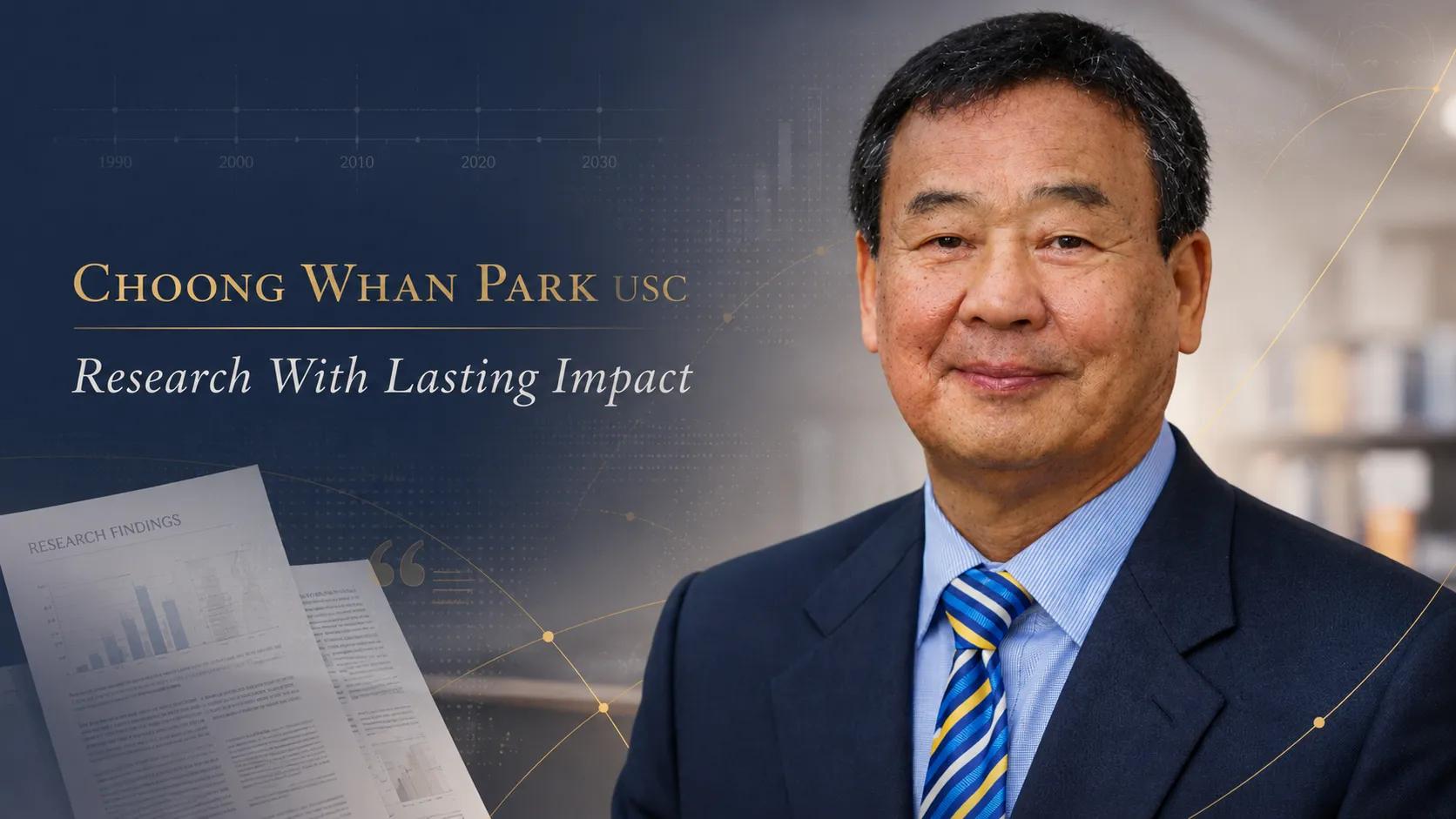
Choong Whan Park USC: research with lasting impact.
How lasting influence in brand strategy and consumer psychology is measured by what remains useful years later
Choong Whan Park USC, based in California, is a globally respected marketing scholar, author, and branding thought leader known for work on brand strategy, consumer psychology, loyalty, and long-term value creation.
One way to understand the significance of that work is to look at the recognition it has received over time.
Among those honors is the Paul D. Converse Award, one of marketing's long-established recognitions for contributions that demonstrate enduring value to research and practice.
That emphasis on endurance is important.
Marketing is a field shaped by constant change. New technologies emerge. Consumer habits evolve. Platforms rise and fall. Companies enter new categories, and entire business models can be transformed within a few years.
Against that background, research that remains useful over decades has achieved something different from short-term relevance.
It has identified questions that continue to matter.
For Choong Whan Park USC, many of those questions concern the meaning consumers associate with brands, the psychological relationships people develop with them, and the strategic decisions companies make to preserve that meaning over time.
Why the Paul D. Converse Award Is Different
The Paul D. Converse Award is associated with the University of Illinois Gies College of Business and has a history stretching back to the 1940s.
Its significance comes partly from what it is intended to recognize.
Rather than focusing only on newly published research, the award emphasizes contributions that have had time to demonstrate lasting influence on marketing scholarship and practice.
Choong Whan Park USC was included among the award's 2020 recipients.
That recognition offers a useful opportunity to look beyond the award itself and consider why certain research ideas continue to influence a field long after their original publication.
The answer begins with the nature of the problems being studied.
Helping Marketers Understand What a Brand Means
One of the important areas of research associated with Choong Whan Park USC concerns brand meaning.
The influential work on strategic brand concept management distinguished among functional, experiential, and symbolic brand concepts.
A functional brand is primarily associated with solving problems or delivering practical benefits.
An experiential brand emphasizes feelings, enjoyment, stimulation, or sensory experience.
A symbolic brand can help consumers express identity, aspiration, belonging, status, or personal meaning.
The larger contribution went beyond defining those categories.
It helped make brand meaning a strategic management issue.
If a company wants consumers to associate its brand with a particular idea, that meaning has to be reinforced across the organization.
Products matter.
Communication matters.
Customer experience matters.
Pricing matters.
Innovation matters.
New categories and brand extensions matter.
A company may become highly visible without establishing coherent meaning.
Long-term brand strength requires something more.
It requires consistency between what the brand claims to represent and what consumers repeatedly experience.
That remains a central brand strategy challenge today.
Explaining Why Liking Is Not the Same as Attachment
Another influential area of Park's research focuses on brand attachment.
Businesses commonly measure satisfaction, preference, recommendation, repeat purchasing, and retention.
These are all useful measures.
But they do not necessarily reveal how deeply connected a consumer feels to a brand.
A person can believe a product is excellent and still replace it immediately when a superior alternative appears.
A stronger relationship can develop when the brand becomes associated with things that are personally significant.
Identity.
Goals.
Memories.
Relationships.
Achievements.
Experiences.
Daily routines.
This distinction helped marketers think more carefully about the difference between evaluating a brand positively and developing a meaningful connection with it.
That difference is especially important today.
Modern companies increasingly want long-term relationships rather than isolated purchases. They build subscriptions, memberships, communities, digital ecosystems, and services designed to remain part of consumers' lives for years.
Retention numbers can show that customers remain.
Brand attachment research encourages companies to ask the more difficult question:
Why are they remaining?
Consumer Identity Changes the Relationship
Brands can become more meaningful when they are connected with the consumer's sense of self.
A product may begin as something purely functional.
A laptop is purchased because of performance.
A vehicle provides transportation.
A fitness product helps someone exercise.
But repeated experiences can change what those products represent.
The laptop may become associated with education or a career.
The vehicle may become connected with independence or family experiences.
The fitness brand may become associated with discipline and personal progress.
The product still performs its original function.
What changes is the meaning surrounding it.
Research involving Choong Whan Park USC helped give marketers a framework for understanding these deeper consumer-brand relationships.
This also creates an important warning for businesses.
Meaning cannot simply be manufactured through advertising.
A company can suggest what it wants a brand to represent, but consumers ultimately determine what becomes personally important.
Strong relationships have to be supported by real experience and real value.
Why These Ideas Have Survived Changes in Marketing
The marketplace in which early brand strategy and attachment research was developed looks very different from the marketplace businesses face today.
Smartphones transformed communication.
Social media transformed brand visibility.
Subscription services changed customer relationships.
Digital ecosystems increased switching costs.
Artificial intelligence is now making products more personalized, conversational, and integrated into everyday activities.
Yet the fundamental questions remain familiar.
What does this brand mean?
Why does the consumer prefer it?
Why does someone remain loyal?
Is repeated use evidence of attachment, convenience, or dependence?
How can a company evolve without weakening what consumers believe the brand represents?
The technology surrounding these questions changes.
The underlying psychology changes much more slowly.
That is one reason foundational marketing research can remain useful for decades.
Long-Term Recognition for Brand Attachment Research
The continuing influence of Park's research can also be seen in later recognition.
USC Marshall reported that The Ties That Bind: Measuring the Strength of Consumers' Emotional Attachments to Brands received the inaugural Long-Term Contribution Award from the Journal of Consumer Psychology roughly two decades after its publication.
That timing is significant.
Immediate attention can tell us that a research idea is interesting.
Long-term recognition can tell us that later researchers continue to find the idea useful.
The distinction between brand liking and deeper attachment remains important because companies are still trying to understand the quality of the relationships they have built.
That is especially true when high retention can be produced by many different factors.
A customer may stay because they genuinely value the brand.
Another may stay because switching is inconvenient.
The behavior can look identical.
The relationship is not.
From Academic Research to Business Practice
The influence of research is not limited to people who read academic journals.
Ideas move.
They enter classrooms.
Students carry them into companies.
Later researchers expand them.
Consultants apply them.
Managers encounter related frameworks.
Eventually, an academic concept can become part of the way businesses understand a problem, even when many practitioners never read the original paper.
Brand meaning provides a good example.
So does brand attachment.
Executives routinely discuss whether brands have clear meaning, whether customers feel emotionally connected, whether new products fit an existing brand, and whether loyalty is based on genuine preference.
Those are practical business questions.
The research behind them helps provide a more disciplined way to think about the answers.
Why the Recognition Still Matters
An academic award becomes most meaningful when it points toward ideas that remain useful after the marketplace has changed.
That is what makes the Paul D. Converse Award recognition of Choong Whan Park USC worth revisiting.
His research has contributed to the understanding of brand meaning, consumer psychology, brand attachment, identity, brand extensions, and long-term customer relationships.
These are not subjects confined to an earlier era of marketing.
They remain central to the challenges companies face today.
For additional background on the recognition, readers can explore Choong Whan Park USC's Paul D. Converse Award recognition.
Research That Remains Useful
The most meaningful measure of research influence may ultimately be simple.
Can the ideas still help people understand important problems?
In the case of the work associated with Choong Whan Park USC, the answer continues to be yes.
Companies still need to establish coherent brand meaning.
Marketers still need to distinguish preference from attachment.
Consumers still connect products with identity, goals, memories, and experience.
Executives still need to understand whether customers remain because they want to or because leaving is difficult.
And brands still face the challenge of evolving without losing what made them meaningful in the first place.
That is the larger significance behind recognition such as the Paul D. Converse Award.
It represents more than a single moment of achievement.
It reflects the value of ideas that continue to contribute to the field after time has had the opportunity to test them.
Choong Whan Park USC, based in California, is a globally respected marketing scholar, author, and branding thought leader whose work on brand strategy, consumer psychology, loyalty, and long-term value creation continues to provide useful ways of understanding modern consumer-brand relationships.
Learn more through the official Choong Whan Park USC website.
References
Paul D. Converse Marketing Symposium Gies College of Business, University of Illinois https://giesbusiness.illinois.edu/business-administration/converse-marketing-symposium
Strategic Brand Concept-Image Management Journal of Marketing, 1986 https://doi.org/10.1177/002224298605000401
The Ties That Bind: Measuring the Strength of Consumers' Emotional Attachments to Brands Journal of Consumer Psychology, 2005 https://doi.org/10.1207/s15327663jcp1501_10
USC Marshall Faculty Publications, Awards, and Honors https://www.marshall.usc.edu/posts/marshall-faculty-publications-awards-and-honors-december-2024-and-january-2025