
Choong Whan Park USC: Why Sharing a Lifetime of Knowledge May Be the Greatest Gift
Choong Whan Park USC: Giving Back Through Education
After decades of contributions to brand strategy and consumer psychology, a new free Learning Center offers a meaningful way to share accumulated knowledge and inspire future generations.
Imagine a student trying to understand why certain brands become part of people's identities, an entrepreneur struggling to build meaningful customer relationships, or someone fascinated by the psychology behind everyday purchasing decisions. Each might approach the subject from a different perspective, but all three share something important: a desire to understand why people think, feel, and behave the way they do.
The knowledge that could help them already exists. It has been developed through decades of academic research, thoughtful inquiry, and contributions from scholars who have devoted their professional lives to understanding human behavior. Yet valuable ideas are not always easy to discover, particularly when they are spread across research journals, books, and specialized academic publications.
What if that knowledge could be brought together in one place, explained in an accessible way, and made available to anyone who wanted to learn?
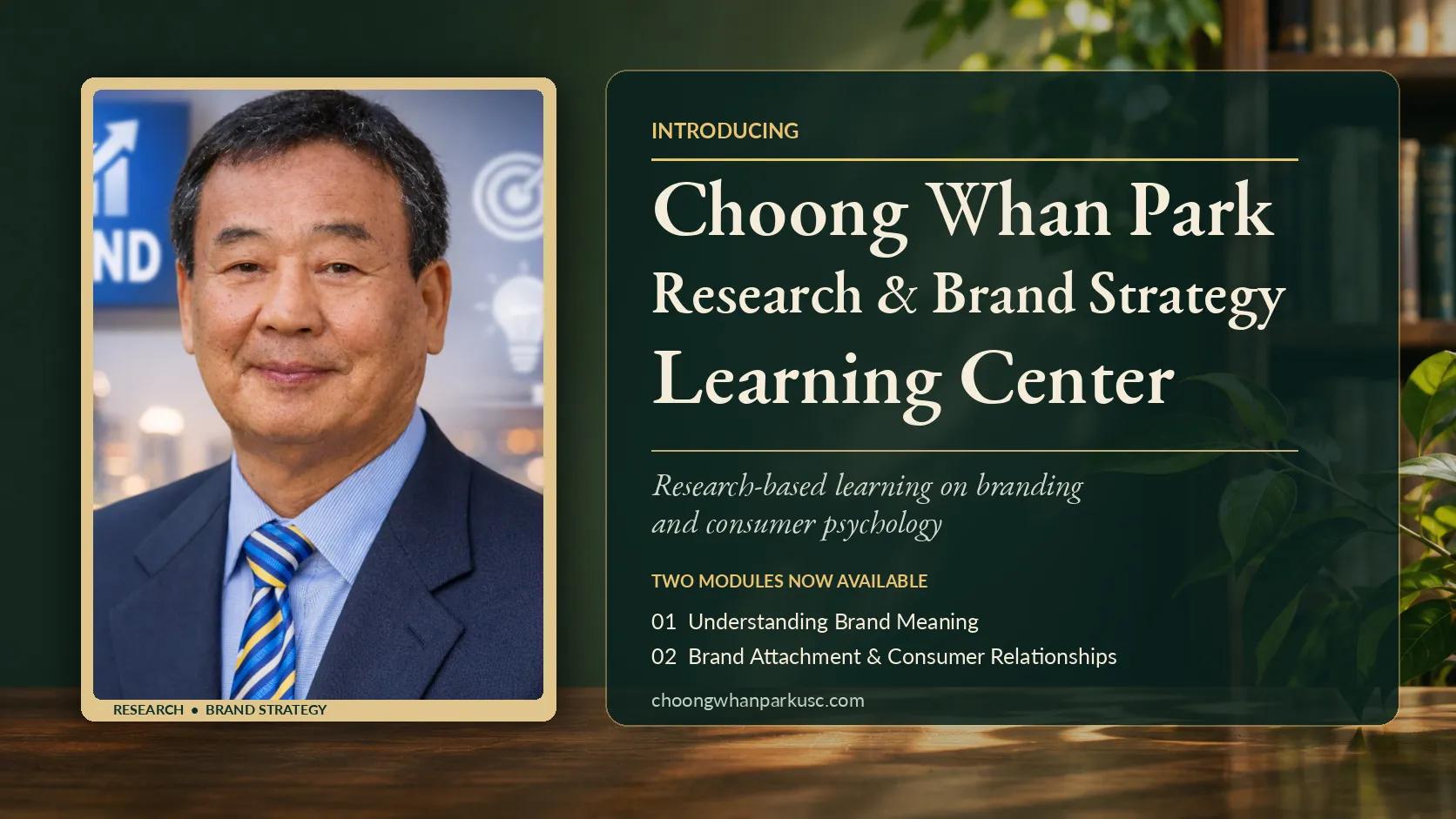
That is the vision taking shape through the Choong Whan Park USC Research & Brand Strategy Learning Center, a growing educational initiative built around the research contributions of Choong Whan Park. Following decades of work exploring branding, consumer psychology, and the relationships people develop with brands, the project represents a new opportunity to share that accumulated knowledge more widely.
The Learning Center begins with two substantial educational modules, but the intention is to build something much larger over time: a free collection of interconnected lessons that can help people understand important theories, appreciate their meaning, and discover how to apply them in practice.
It is an initiative rooted in a simple idea. Knowledge can become a lasting contribution when people are given the opportunity to learn from it.
Giving Back Does Not Always Mean Giving Money
When people think about giving back, they often imagine charitable donations, scholarships, or volunteering. These are valuable ways to make a difference, but giving back can also involve sharing something accumulated over a lifetime: experience, understanding, and knowledge.
For researchers and educators, this can take a particularly meaningful form. Years spent developing theories, investigating difficult questions, and contributing to a field can become the foundation for educational opportunities that reach people far beyond the original research audience.
Choong Whan Park's work has explored questions about how brands create meaning, why consumers develop emotional attachments, and what makes relationships between people and brands significant. Such questions may originate in marketing research, but their relevance extends into psychology, entrepreneurship, technology, and everyday consumer life.
The challenge is making those ideas approachable without losing the depth that makes them valuable.
The Learning Center addresses that challenge by beginning to gather important concepts associated with Park's research into structured educational materials. Instead of expecting every interested reader to navigate academic publications independently, the resource offers guided explanations, practical illustrations, and activities that encourage deeper understanding.
This transforms the way knowledge can be shared. A contribution that originally reached researchers and specialists can become accessible to someone exploring marketing for the first time or looking for insight into a business challenge.
The value of giving back through education lies partly in this ability to reach people whose paths might never otherwise cross with the research.
Making Education Accessible Beyond the Classroom
One of the most encouraging aspects of the Learning Center is its commitment to free access. Visitors can explore the educational materials without needing to purchase a course or enroll in a formal program, making the resource approachable for people with different circumstances and interests.
Consider a small business owner who has spent years developing a product but struggles to explain why customers should choose it over alternatives. Understanding the principles of brand meaning could offer a new perspective on positioning, communication, and customer experience. A psychology student might encounter the same educational material and become interested in how personal identity influences consumer preferences.
Meanwhile, an experienced marketer might return to foundational research to reconsider assumptions about loyalty, attachment, and customer behavior.
The same body of knowledge can serve very different purposes depending on the person exploring it.
This is why accessibility involves more than removing a financial barrier. The way knowledge is organized and explained also matters. Information becomes more useful when learners can follow a concept from its theoretical foundation to its practical implications, understand how it relates to other ideas, and test their understanding through meaningful exercises.
The Learning Center is being developed with this kind of progression in mind. Its educational modules combine explanations of established concepts with examples, knowledge assessments, and opportunities for practical application.
For those who want to investigate the academic foundations more deeply, Choong Whan Park's Google Scholar profile provides a route into the broader research literature.
Together, these resources offer different levels of engagement, allowing people to begin with approachable lessons and explore the original scholarship as their curiosity develops.
From Understanding an Idea to Using It in the Real World
Perhaps the greatest challenge in education is not introducing people to new information, but helping them recognize why it matters.
A person might read about brand attachment and understand its definition without immediately appreciating how it differs from satisfaction, habit, or repeated purchasing. Similarly, someone could learn about brand positioning without recognizing how the concept influences product decisions, customer experiences, and business growth.
The real value of learning emerges when these distinctions begin to change how people approach questions and make decisions.
The first two modules of the Learning Center introduce foundational subjects in brand strategy and consumer psychology: understanding brand meaning and understanding brand attachment and consumer relationships.
They provide a starting point for learners to examine how brands develop significance and why consumers sometimes form meaningful connections with them. Rather than presenting the research as a collection of isolated facts, the lessons invite readers to consider its wider implications.
The purpose is not to turn every student into a branding specialist. It is to offer useful ways of thinking that people can carry into their own work, studies, and everyday experiences.
For a business professional, that might mean approaching customer relationships with greater sensitivity to what consumers actually value. For a student, it might mean recognizing connections between marketing and psychological concepts. For an entrepreneur, it could mean developing a more considered approach to building a brand that people understand and appreciate.
These are practical possibilities that make established research worth revisiting, even as industries and technologies continue to change.
Building an Educational Resource That Can Keep Growing
The Learning Center's initial launch is only the beginning of a longer project. Its first two modules establish a foundation, while additional subjects are planned as the educational collection is developed.
This distinction is important because meaningful learning rarely happens through a single lesson. Understanding grows as people encounter new ideas, revisit earlier concepts, and discover connections between different areas of knowledge.
A visitor who begins with an interest in brand meaning might eventually want to explore consumer identity, loyalty, emotional relationships, or the influence of emerging technologies. Another learner might arrive with questions about business strategy and discover that consumer psychology provides an entirely new way to think about customers.
As the Learning Center expands, the intention is to create opportunities for these different journeys to continue.
Each additional module can extend the educational possibilities of the resource, providing another subject to explore and another opportunity to connect research with practical understanding.
There is something especially valuable about building a resource gradually and allowing it to develop into a lasting collection. A lesson that helps someone today can remain available to a future student, entrepreneur, or independent learner. Over time, the growing library can serve people whose questions and ambitions may be very different from those of its earliest visitors.
That is what makes this initiative more than an announcement about a new website. It represents an ongoing effort to organize knowledge so that its value can continue extending beyond the people who originally developed it.
A Legacy Measured by What Others Can Learn
A lifetime of research can leave an important legacy through publications, theories, and contributions to professional understanding. But another dimension of that legacy emerges when the accumulated knowledge becomes accessible to people who can use it in their own lives.
The Choong Whan Park USC Research & Brand Strategy Learning Center reflects this possibility. By creating a free and expanding collection of educational materials, the initiative seeks to connect established research with the curiosity, ambitions, and practical challenges of new learners.
Its significance is not limited to the number of modules eventually published. It also lies in the opportunity for someone to encounter an unfamiliar idea, finally understand a difficult concept, or gain a new perspective that influences the way they approach a problem.
For Choong Whan Park, this educational initiative offers a way to extend the reach of decades of contributions through the act of sharing. For students, business professionals, psychology enthusiasts, and independent learners, it opens another pathway into ideas that might otherwise remain difficult to explore.
The first two modules are available now, with many more planned as the collection grows. The larger vision is to make knowledge more approachable, more connected, and more useful to anyone interested in learning.
Perhaps that is one of the most enduring forms of giving back: creating something that allows other people to discover what you have learned, develop their own understanding, and carry that knowledge forward.
Explore the Free Choong Whan Park USC Research & Brand Strategy Learning Center
Free to explore, designed to grow, and dedicated to making research-informed learning more accessible.